Democracy Can’t Defend Itself Against Bad Faith. Unless …
Fascism's success is based on its adjustment to and exploitation of liberal democracy

In this post-literate age, where no one reads and no one knows about what came before them, there exists a maddening tendency among our elites – those yanking the levers of power up and down according to the instructions of those who fill their checking accounts – to see every problem as unprecedented and intractable.
With every challenge to American democracy comes a flurry of panicked questions: How can this challenge to our republic be countered? What can be done to stop these bad actors who refuse to recognize as legitimate our democratic system of checks and balances? The answer, more often than not, is to tell people to Vote Even Harder. Maybe then the bad actors will see the error of their ways, fall in line, and play by our rules.
I appreciate the folks who support BFT. Consider subscribing for $3 or $5 a month, or leaving a tip!
After all, you voted so hard. They can’t deny the vigor of your voting. That, we say, would be wrong.
Begging decent people to vote every four years in favor of self governance and against anti-democracy forces funded by men with bottomless money pits is no way to defend and safeguard democracy or the institutions that enforce it and perpetuate it. Nothing pro-democracy politicians and organizations have done in the United States over this past disorienting decade is sustainable. A country cannot have a major political party that seeks to dissolve its democracy in a vat of battery acid. A country cannot swing back and forth between a center-left technocratic party and a vicious autocratic party that has allied with authoritarians and capitalists across the world in pursuit of a world free from the modest restraints of democracy.
 Denny Carter
Leaders in Canada and Europe (and elsewhere) have recognized this. Functional democracies are sick and fucking tired of America’s refusal to defend its democracy. It’s why the reputational damage of this second Trump regime will be permanent. If enemies of democracy are allowed to participate in your democracy, the world has said, then you’re on your own. Good luck maintaining sufficient dopamine levels in a collapsing empire.
Here’s the thing about elites and powerbrokers in the US throwing up their hands and saying the only thing we can do to save democracy is win every election for the rest of eternity: It doesn’t have to be this way. Other countries – maybe not superpowers, but big nations with lots of people – have looked for ways to defend their democratic republics from those who have no interest in upholding that system of governance. Leaders of the Brazilian government, after beating back a broad-base autocratic movement in 2022, have forcefully pushed back against the Trump regime’s bad-faith efforts to undermine its upcoming elections, as one example.
Elected Brazilian leaders see autocratic forces lining up at their gates, doing their best to hide their fangs, asking if they can just take a quick peak inside, and they have said no, get the fuck out of here. It’s respectable. I’m jealous.
A look back at (relative) recent history can show us that democracy does not have to be a defenseless punching bag for its enemies (mostly people who will do anything in service of capital’s always-expanding and all-consuming logic). There is, it turns out, a militant form of democracy that not only recognizes bad-faith actors looking to kill it, but bars them from the chance to strike a republic-ending deathblow.
'Democracy must deny its enemies the democratic privileges'
Most of my Bad Faith Times blogging over the past four years can be boiled down to one basic and frightening question: Can a democracy defend itself against bad-faith politics, or is bad-faith politics and legalism the One Weird Trick for torching self governance and replacing it with authoritarian rule, complete with the window dressing of meaningless elections?
Maybe the most vexxing aspect of the past decade of fascist political domination in the US is the fascsists’ ability to speak the language of democracy. Sometimes they slip and say what they mean, but mostly they are disciplined in talking the talk of small-d democrats. One example: When the fascist movement needs to make the electoral environment more favorable for their cause, its representatives on the land’s highest court make it so while feigning allegiance to the constitutional order. As loyal BFT readers know, their familiarity with how to talk like a democracy backer – their wearing of a small-d democrat mask – makes it exceedingly difficult to wake normies to the existential threat they represent to the very idea of self governance.
 Denny Carter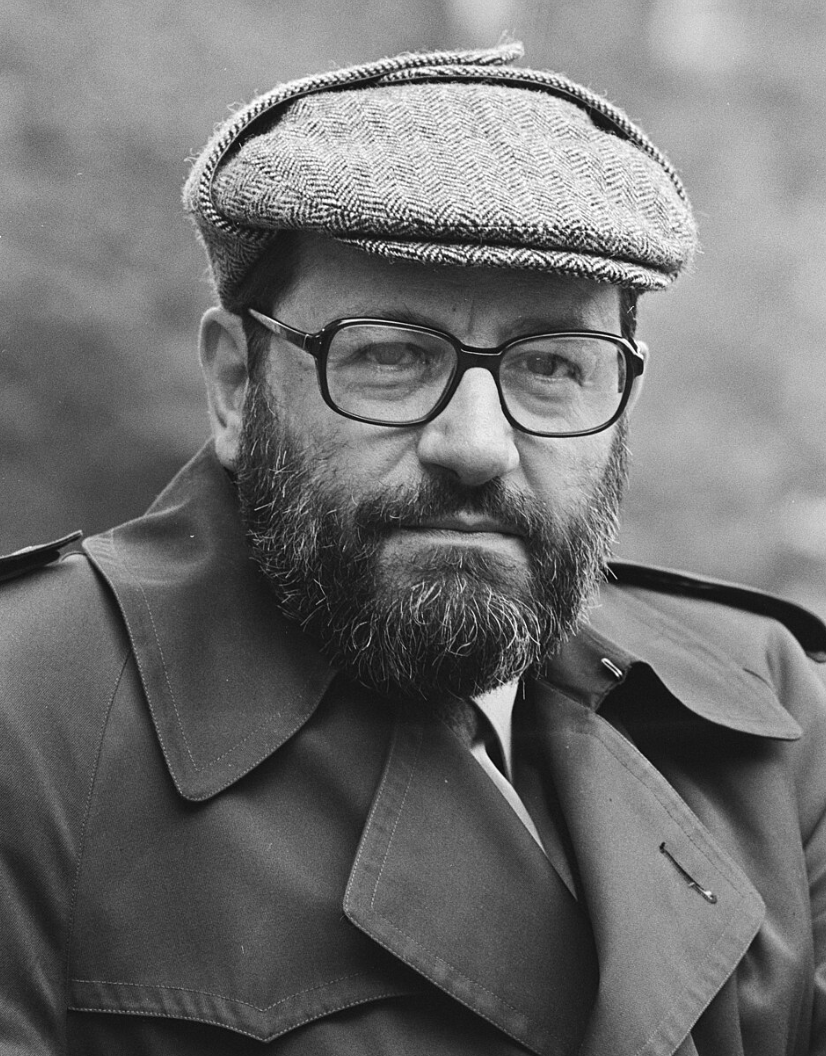
This mask wearing and the potential use of democratic norms to destroy democracy is what worried German political leaders, philosophers, and intellectuals in the years after the Third Reich’s fall. Politically and culturally, nothing remained; the slate was clear. There was a chance, German liberals knew, to establish a version of democratic self rule that could not be so easily hacked by those determined to destroy it. They would have a shot to create a form of self governance complete with safeguards that hadn’t existed the last time they needed it. What these small-d German democrats envisioned was a system of self rule with a defense.
“[Democracy] must become militant,” German constitutional lawyer Karl Loewenstein wrote in 1946, a year after the end of World War II, the trauma of a massacred democratic order still fresh in the minds of Germans who had enjoyed a thriving liberal democracy for years and years before Hitler’s rise and German political elites' capitulation to the bad man.
Democracy, Loewenstein said, needed a defense, and that defense could only take one form: Excluding political groups and movements that sought to undermine or end democratic self rule.
"[Democracy's] principles and institutions need conscious legislative protection against its internal enemies. Antidemocratic propaganda may still be protected by freedom of political opinion, but only as long as it abstains from consolidating itself into an organization for the attainment of its aims. … Political democracy can no longer tolerate political groups, parties, movements whose admitted and implied aim is to annihilate it. The inescapable lesson of the past is that political democracy must rigorously deny its enemies the democratic privileges."
Democracy's inherent willingness to let anyone play its game and let anyone bye for power, Loewenstein argued, all but ensured democracy's death. Though he didn't use this kind of language, Loewenstein seems to understand that (non-militant) democracy relies on everyone operating in good faith, saying what they mean, being honest about their aims and goals for a government and its people. Loewenstein, after watching Germany's liberal democracy crumble with hardly any resistance, rejected these impossible standards for a functioning democratic republic. Expecting good-faith angels to do fair and reasonable political battle, Loewenstein implied, was dangerously naive.
Democracies should not be made to sign their own death warrants, he argued. And no democratic republic could (or should) rely on a "common front" defense of the system in which anti-fascist parties coalesce and defeat the fascists at the ballot box over and over again. Loewenstein, after all, had seen more moderate center and center-left parties refuse to team up with far-left and communist parties while the Nazis gradually gained power and influence in German politics. The people, he said, could not rely on the "common front idea" as a final safeguard against anti-constitutional forces taking charge.
“Totalitarian dictatorship arose not because of the satanic power of superior leaders – after all, genius is limited in numbers even among the strong men of our period – but because a lenient and generous liberal democracy granted the same political rights to movements, parties, and persons that were admittedly anti-democratic as to those faithful to democratic principles.”
[Fascism] could be victorious only under the extraordinary conditions offered by democratic institutions. Its success is based on its perfect adjustment to democracy. Democracy and democratic tolerance have been used for their own destruction. Under cover of fundamental rights and the rule of law, the anti-democratic machine could be built up and set in motion legally. Calculating adroitly that democracy could not, without self-abnegation, deny to any body of public opinion the full use of the free institutions of speech, press, assembly, and parliamentary participation, fascist exponents systematically discredit the democratic order and make it unworkable by paralyzing its functions until chaos reigns. They exploit the tolerant confidence of democratic ideology that in the long run truth is stronger than falsehood, that the spirit asserts itself against force. Democracy was unable to forbid the enemies of its very existence the use of democratic instrumentalities. Until very recently, democratic fundamentalism and legalistic blindness were unwilling to realize that the mechanism of democracy is the Trojan horse by which the enemy enters the city. To fascism in the guise of a legally recognized political party were accorded all the opportunities of democratic institution.
"Fascism simply wants to rule," Loewenstein wrote, echoing the words of Italian philosopher Umberto Eco, who described fascist movements of his time as a "fuzzy" kind of totalitarianism with no real goals beyond power and domination. This would have sounded foreign to Americans ten years ago. Today it sounds terribly familiar.
Democracies are legally bound to allow the emergence and rise of anti-parliamentarian and anti-democratic parties under the condition that they conform outwardly to the principles of legality and free play of public opinion," Loewenstein wrote. "It is the exaggerated formalism of the rule of law which under the enchantment of formal equality does not see fit to exclude from the game parties that deny the very existence of its rule."
If the main principle of democracy is "the notion of legality," then fascist parties that seize power via democratic means "officially annex legality," he continued. This lies at the heart of bad-faith politics.
This concept of a militant democracy was baked into Germany's Basic Law, which allows the government to take preemptive steps against political parties that seek an end to constitutional rule. It's why the current German government is monitoring and surveilling the fascist party known as Alternative for Germany as it makes electoral gains with financial backing from international fascist leader Elon Musk. Ethnically cleansing the country, as AfD leaders have talked about for years, is not exactly in line with upholding constitutional rights.
 Denny Carter
Under German law, if a party “seeks to undermine or abolish the free democratic basic order or to endanger the existence of the Federal Republic of Germany” and takes an "actively belligerent, aggressive stance vis-à-vis the free democratic basic order," party leaders can be legally monitored by the state. If these conditions are satisfied – as determined by the country's nonpartisan Federal Constitutional Court – and it's determined that the party could conceivably achieve its "anti-constitutional" aims, the party is banned from local and national elections. It's happened a few times in German history, mostly in the years after World War II with the embers of fascism still burning in parts of Europe.
Banning anti-constitutional parties in Germany isn't a slam dunk though; there are durable safeguards to booting parties from elections for political reasons. The Federal Constitutional Court has ruled twice in the 2000s not to ban a far-right party known as NPD because the court determined NPD – a small, unpopular fringe party – had no viable path to gaining power. It posed no threat to the constitutional order; its leaders were allowed to keep shouting into the void about immigrants and Jews and whoever else they hate.
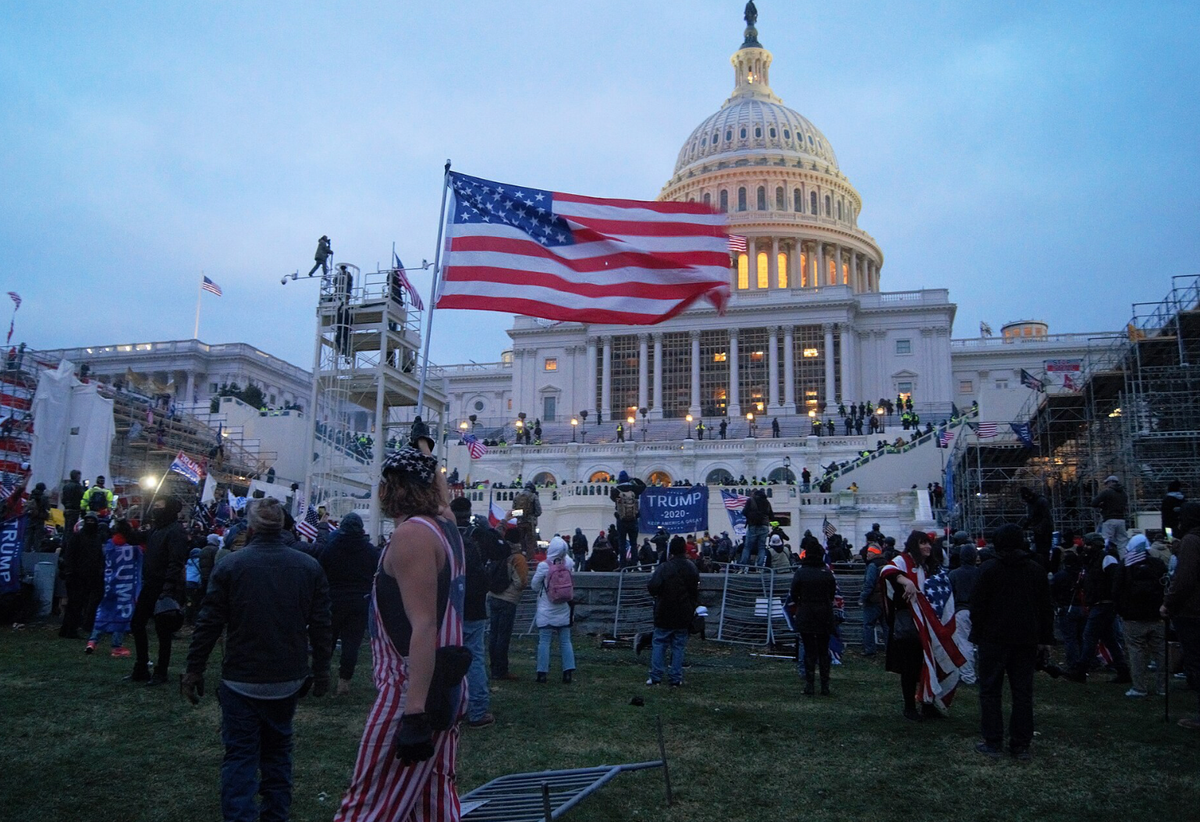
There are, it turns out, a bunch of options for militarizing democracy against its many enemies, people who understand exactly how to slice open the system's soft underbelly and let it bleed out. In the US we have a racist former game show host who understood in his marrow how to turn a 250-year-old republic against itself. Then one day, four years after accidentally winning the presidency, this racist game show fella tried to violently overthrow the U.S. government, and while there were some hopeful efforts to ban him from further participation in the system he sought to destroy, the captured institution we call the Supreme Court neutered those efforts and left the country defenseless against its greatest enemy and the anti-constitutional movement he leads.
The land's highest court said the insurrectionist could slice at democracy's underbelly as much as he wanted. There is no limit to the damage he can do, they ruled. That's his right in a democracy.
Follow Denny Carter on BlueSky at @dennycarter.bsky.social.