We Live In A Society (Really)
If the left doesn't take anti-social behavior seriously, voters will turn to the right for solutions
Today's BFT newsletter was written by Nick, a fella I met on Bluesky who had what I thought was a good take that could make an even better BFT blog post. You can follow Nick on Bluesky.
I was going to begin this blog by revisiting the toxic discourse around a 2023 tweet about smoking on the train by Mindy Isser, a left-leaning Philadelphia organizer who posts mostly about the labor movement.
Isser's innocuous post set off a cascade of increasingly wild-eyed replies and devolved into a days-long social media war in which no prisoners were taken.
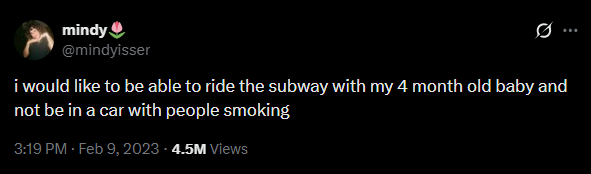
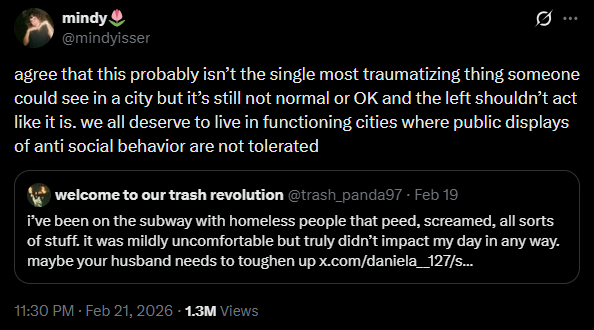
It turns out almost three years to the day after this legendarily controversial post, Isser was embroiled in an almost identical debate about antisocial behavior in public spaces. The response to both posts elicited the same arguments: Isser is too soft, she hates the unhoused, she should move out of the city if she wants to avoid people masturbating on public transit.
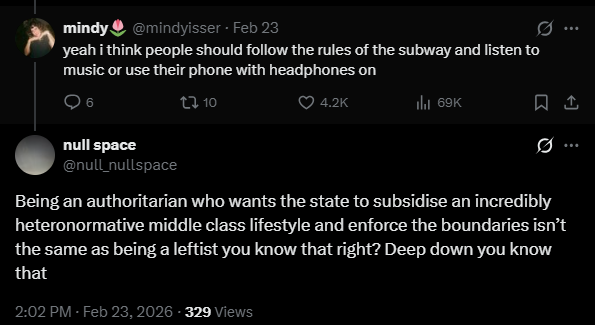
Isser then gets accused of being the “headphone police,” which produced this perfect “how did we end up here?” moment:
This kind of discourse catches fire on Bluesky every so often (as it did on Twitter, and apparently still does on the X platform) and I think it’s worth addressing.
The controversy du jour was spun up around a post discussing an unhoused man throwing a rock into a post office window. I don’t want to re-litigate that post, which, to be clear, ended with pleas for more government-funded shelters and better mental health services (the original post has since been deleted but here’s the screen grab that was my introduction to the issue). I’m more interested in this response: Did you talk to him? Did he say he had no reason? No. More likely this is just an assumption. or worse, complete bullshit made up to generate public distrust of the houseless.”
 Denny Carter
I’m fascinated by the desire to ask the guy why he threw a rock through the post office window, the question implying the existence of one or even a handful of good reasons to do so. While they might not accept the particulars of the permission structure, people making this argument – knowingly or not – are in agreement with the American right on the praxis (do whatever the fuck you want and have zero consideration for anyone else).
The right says this is OK and even laudable because you’re in charge, this is your life, your country, and you have a god-given right to behave in any way you want to behave. The “public urination is fine” left is saying it’s OK because you aren’t in charge, life is unfair, and human beings have no agency.
The right is built on the idea that everything is atomized and individualized; success or failure, it’s all about you and your hard work (or cranial dimensions). The left rejects this framing by suggesting social problems are systemic—that there are intertwining systems built into society to benefit the few at the expense of the many. The idea that these systems affect entire populations and supersede or suppress individual traits and actions is what produces the demands for a robust social safety net and a path for comfort and stability for all. This is a good thing.
But thanks to the nuance-flattening properties of social media, a small quorum of terminally online leftists have internalized systemic thinking to the degree of no longer believing in individual agency. Their working assumption appears to be that everything is a logical reaction to an oppressive force. It’s not dissimilar to the overextension of therapy-thought that has convinced online self-care dead-enders that you’re never the asshole and never need to take responsibility. This is how you end up with a multiple-day pile-on dissecting whether it's "ableist" to give homemade chili to your neighbor.
It would be difficult to exaggerate how much this sort of discourse alienates what we might call political normies: Folks who vote but who don't spent six or eight or ten hours a day engaging in the minutia of inside-baseball political culture. Making excuses for someone throwing rocks through a window or pissing all over a bus or a subway car or blasting their music for everyone to hear is a huge turnoff for people like this, who will hear these justifications and turn to someone – anyone – who will solve the problem of rock throwing and bus pissing. Often that means empowering Republicans whose solution is to simply imprison the people in question.
 Andy Elrick
It all comes from the same place of outsourcing responsibility to others. Using the concept of systemic oppression to excuse shitty, anti-social behavior, I'd argue, is infantilizing and insulting to people on the ground trying to build the liberal-left project that might get a chance to thrive post-Trump.
I’m reminded of my friend Tim’s post:
“a lot of young leftists correctly realize the carceral state is bad but lack the creativity or stamina to engage with real solutions so sort of accidentally end up with ‘uh, the crime is good’ and then wonder why that makes people upset.”
Tim is arguing in the context of anti-carceral leftism but the same attitude plays out in the discussions of American class and power dynamics more generally. The argument goes that anti-social behavior is merely a symptom of a bigger problem and worrying about it is but a distraction from solving the bigger problem of mass poverty and mental health, or worse, a way to further oppress marginalized people.
But if focusing on the behavior at the expense of trying to solve the bigger issues is missing the forest for the trees, then ignoring anti-social behavior in favor of large-scale societal changes is effectively denial that individual trees exist at all.
I think the "everything that happens in urban public spaces is ok" is the opposing horeshoe end of "urban public spaces are war zones". Both opinions emanate from people who spend little or no time in urban public spaces.
— Gerkinov 🌻 (@gerkinov.bsky.social) 2026-03-26T15:34:25.965Z
I'm not arguing that this represents a large faction of the American left, nor is it anything elected officials or organizers are claiming. It's little more than discourse about social media posts on a dying breed of text-based social media apps. But I think it's important for anyone interested in growing the coalition to be precise about these things, especially in an era when journalists and political tastemakers are as online as anyone, and any random poster can be platformed by right-wing media outlets as spokespeople for the Democratic Party.
“We live in a society” – and its cousin phrase, “A better world is possible” – is often lobbed at the right as a criticism of its selfish worldview and inability to empathize with those in need. But it also suggests there is some sort of baseline social respect worth protecting; that the better, more equal world people are building together should make room for everyone. That, yes, people living on the street or in extreme poverty deserve mental health care and economic stability, but also that kids and women and the elderly should feel safe in public. These ideas are not inherently at odds; claiming so is effectively ceding the public masturbation/urination issue to the right wing, and we all know how they would prefer to solve it.
Follow Nick on Bluesky at @nickhasthoughts.com.
Comments ()